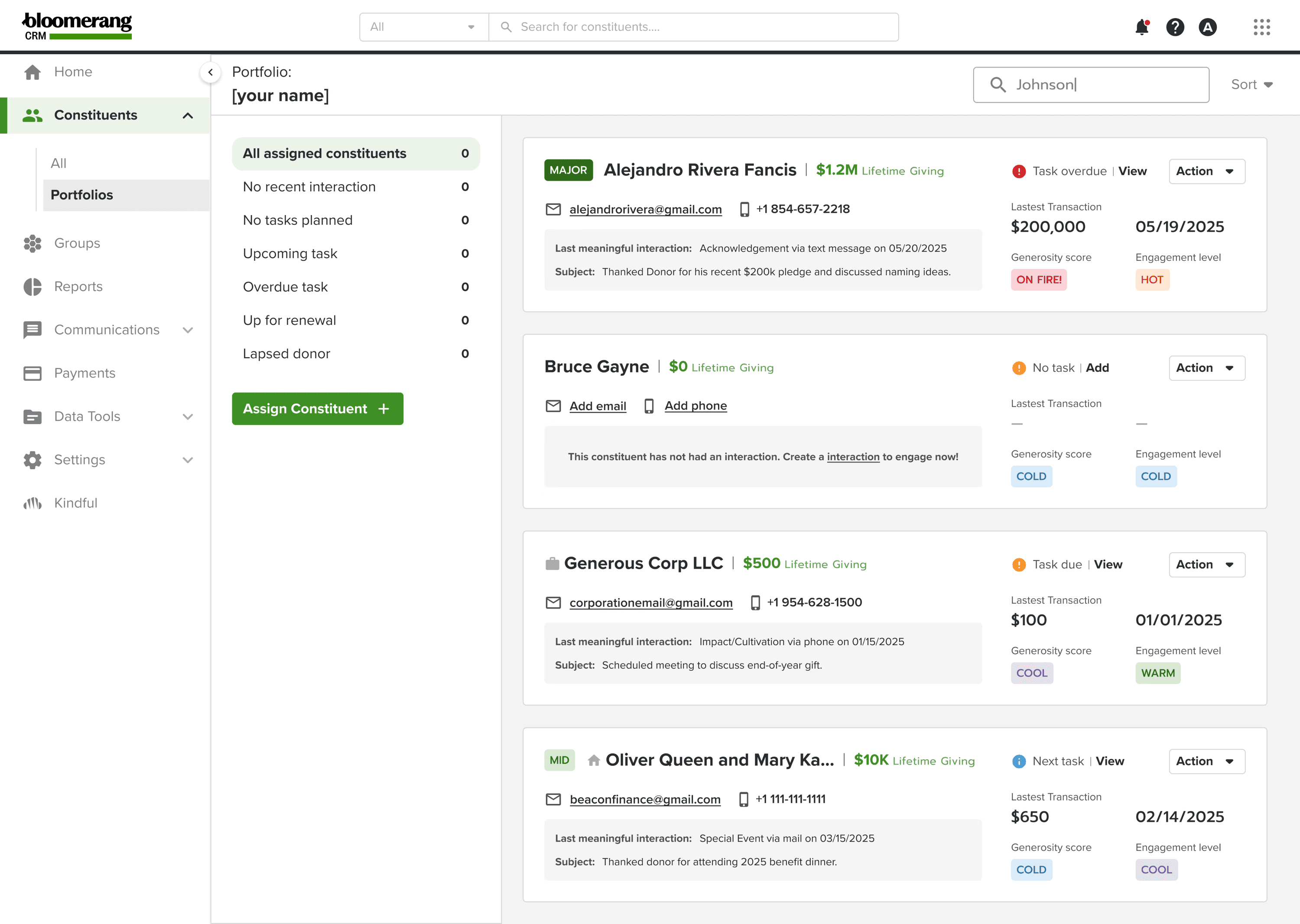
Designing a centralized CRM dashboard that gives major gift fundraisers an at-a-glance view of their portfolio — reducing manual effort, streamlining workflows, and helping them build stronger donor relationships.
Overview
Bloomerang is a CRM built for nonprofits. Major gift fundraisers — relationship managers — are responsible for cultivating and stewarding high-value donors. But the existing CRM wasn't built with their workflow in mind.
This project focused on designing a comprehensive relationship manager dashboard to help major gift fundraisers manage and engage with their portfolios more efficiently — centralizing key information, streamlining workflows, and reducing the manual effort that was pulling them away from actual relationship-building.
The Problem
Relationship managers were struggling with fragmented data and inefficient workflows when managing major donor portfolios. The pain points were consistent across users.
Difficulty summarizing past giving and interactions — data lived in too many places across the CRM.
Challenges tracking upcoming tasks and prioritizing engagement efforts across a large portfolio.
Creating tasks for each constituent required too many steps, pulling managers away from donor work.
Limited ability to calculate key performance indicators like revenue and interaction count within the CRM.
Relationship managers were organizing and planning in external spreadsheets because the CRM couldn't meet their needs. Spreadsheets are a design signal — when users solve product problems with external tools, the product isn't meeting their needs.
User Research
To ensure the design met real user needs, we ran a multi-phase research process before committing to any direction.
Surveyed relationship managers to understand top priorities and pain points — determining which features mattered most, including task prioritization, donor engagement metrics, and streamlined task creation.
Created an initial prototype and sent it out for testing. This validated ideas early, surfaced feedback on the interface, and revealed how users naturally interacted with the dashboard.
Conducted in-depth interviews with relationship managers working directly in the prototype. Learned what they valued most, what still needed solving, and which features would most meaningfully improve their day-to-day.
Solution
The goal was to give relationship managers an at-a-glance view of their portfolio's health and key information about each constituent — without requiring them to dig through individual profiles or switch between tools.
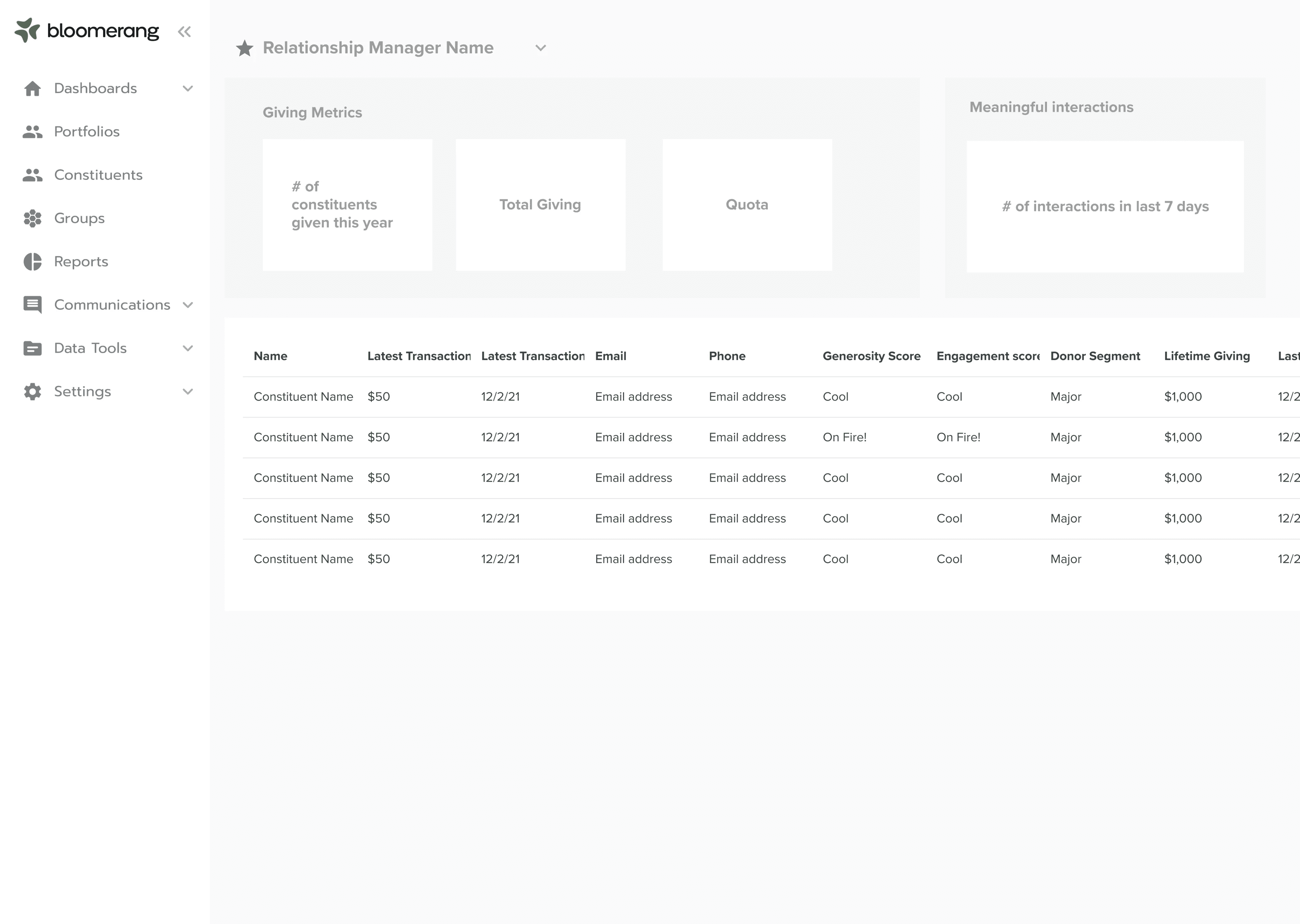
Dashboard design explorations informed by user research
Key details like lifetime giving, donor segment, engagement score, and recent interactions — visible at a glance without diving into individual profiles.
Constituents flagged automatically based on overdue tasks, lack of recent interactions, or upcoming renewal dates — keeping managers focused on high-priority outreach.
Create tasks, log interactions, and initiate emails or calls directly from the dashboard — no context-switching required.
Key metrics like meaningful interactions, total giving for the fiscal year, and progress toward fundraising goals — all surfaced without manual calculation.
Outcome
The dashboard gave relationship managers a centralized, easy-to-use tool that streamlined their workflow. With key donor data at their fingertips, they could quickly identify high-priority constituents, track interactions, and plan outreach more effectively.
The result was a more organized, efficient approach to major gift fundraising — helping relationship managers build stronger connections with donors and ultimately raise more funds for the nonprofits they serve.
Reflections
Running surveys and prototype tests before committing to a direction meant we weren't designing in a vacuum. The 10+ interviews surfaced nuances no assumption could have uncovered.
The dashboard needed to surface a lot of information without overwhelming users. The constraint forced rigorous prioritization — every element had to earn its place.
The biggest shift was designing around how fundraisers actually work — not around what the CRM already did. That reframe changed every decision we made.
When users are solving product problems with external tools, that's a clear sign the product isn't meeting their needs. Eliminating that workaround became the north star.